
Oxidative Stress-Mediated Pathophysiology and Apoptotic Regulation in Oral Squamous Cell Carcinoma Induced by Smokeless Tobacco
DOI:
https://doi.org/10.4238/bp8n7006Keywords:
Oral squamous cell carcinoma, Oxidative stress, Apoptosis, Redox biomarkers, BCL-2Abstract
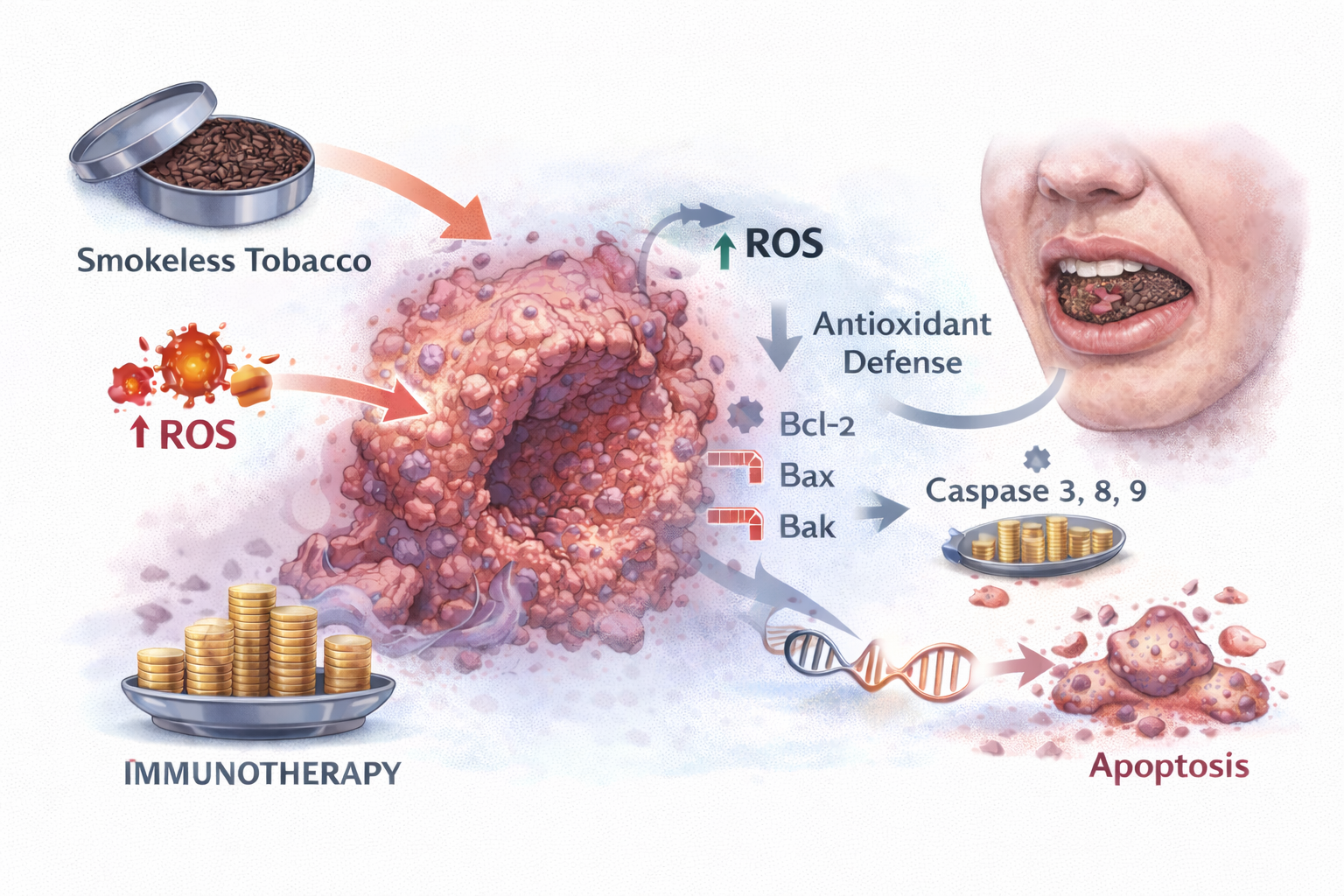
Objectives: This investigation explores the role of oxidative stress in the development of oral squamous cell carcinoma (OSCC), particularly in individuals with a history of smokeless tobacco use. By examining the disruption of mitochondrial function and activation of apoptosis-related genes, the study provides insight into the biological mechanisms underlying OSCC. With smokeless tobacco being widely used in South Asia and strongly linked to oral cancers, the findings aim to enhance understanding of disease etiology and support the identification of early molecular biomarkers. Methods: The study cohort included OSCC patients with a history of smokeless tobacco use and matched healthy controls. Biomarkers of oxidative stress—including reactive oxygen species (ROS), malondialdehyde (MDA), and antioxidant enzymes such as superoxide dismutase (SOD), catalase (CAT), and glutathione peroxidase (GPx)were quantified using standard spectrophotometric techniques. Expression levels of apoptosis-associated genes, namely BAX, BCL-2, CASPASE-3, and TP53, were evaluated through reverse transcription quantitative PCR (RT-qPCR) and further validated via immunohistochemical staining. Mitochondrial membrane potential (Δψm) was assessed using JC-1 fluorescent dye and flow cytometry. Comparative statistical analysis between case and control groups was performed using one-way ANOVA and Student’s t-test, with a p-value below 0.05 considered statistically significant. Results: The analysis shows that oral squamous cell carcinoma (OSCC) tissues from smokeless tobacco users exhibited a substantial elevation in reactive oxygen species (ROS) and malondialdehyde (MDA) levels, alongside a notable decrease in the activity of antioxidant enzymes such as superoxide dismutase (SOD) and glutathione peroxidase (GPx) (p < 0.001). The increase in apoptosis was further supported by the upregulation of the pro-apoptotic protein BAX. and CASPASE-3, decreased BCL-2, and p53 nuclear accumulation, suggesting additional complexity in augmenting apoptosis. There's also a considerable increase in mitochondrial depolarization in OSCC cells, which contributes to loss of energy control and energy-dependent apoptosis threshold. Conclusion: From the results obtained, it can be concluded that smokeless tobacco potentially contributes to the development of oral squamous cell carcinoma (OSCC) by inducing oxidative stress-based mitochondrial damage and dysregulated apoptosis. As proposed in this study, SOD, GPx, and other redox-sensitive apoptotic regulators may anticipate neoplastic change and endorse intervention for cancer chemoprevention that targets ROS in tobacco-related OSCC.
Downloads
Published
Issue
Section
License
Copyright (c) 2025 Ginu Anie Joseph, Dr.Minerva Singh, Sumeet Singh Sarpal, Dr.Bhushan Kumar, Dr.Sudam Sadangi, Dr.Mayur Dodiya (Author)

This work is licensed under a Creative Commons Attribution-ShareAlike 4.0 International License.


