
Where Communities Preserve Genes: SCoT-Based Genetic Assessment of Dipterocarpus alatus Roxb. Ex G.Don in Thailand
DOI:
https://doi.org/10.4238/1jgnd844Keywords:
Dipterocarpus alatus, SCoT markers, genetic diversity, population structure, community forest, conservation geneticsAbstract
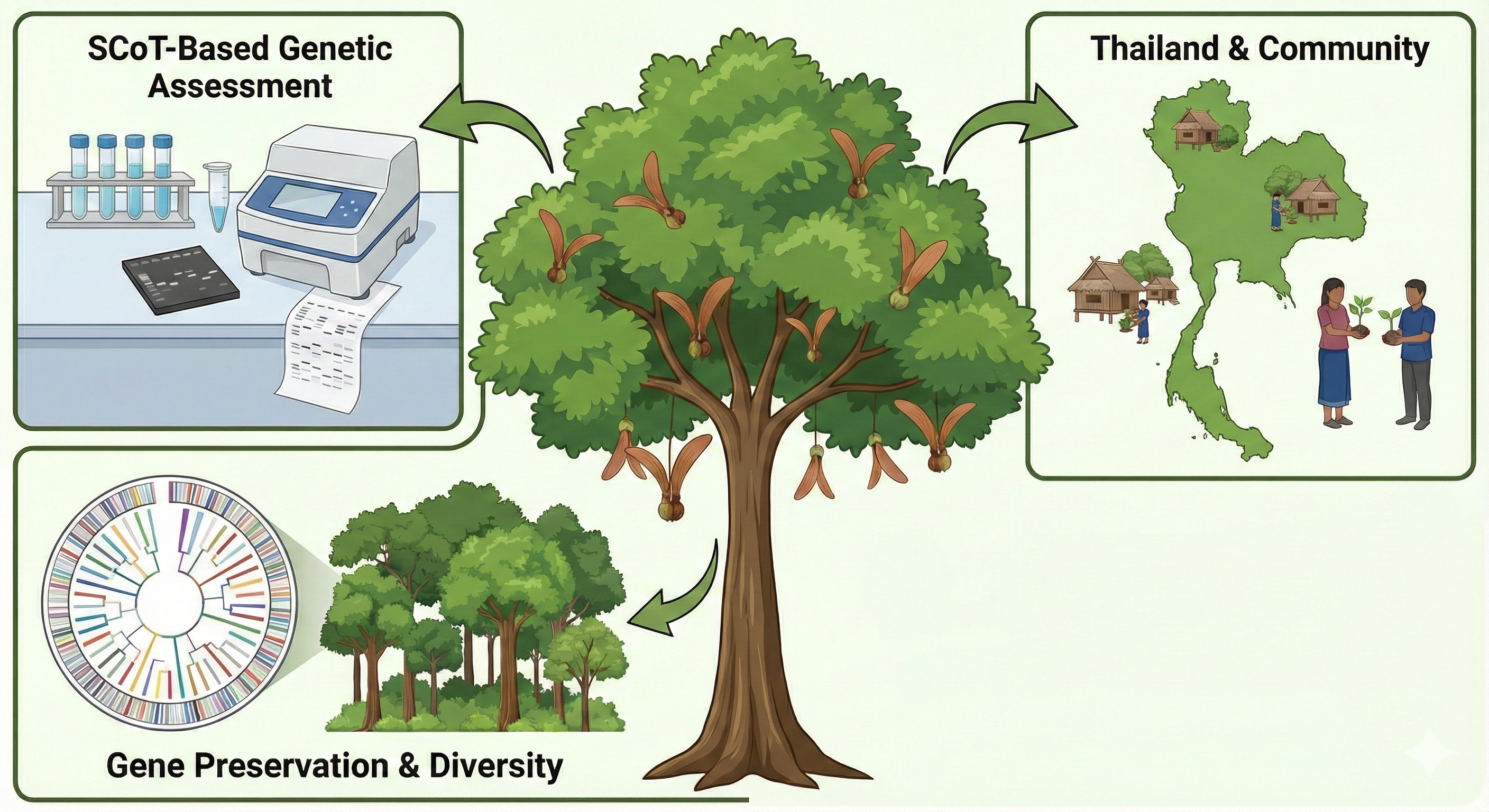
Dipterocarpus alatus Roxb. ex G.Don is an ecologically and economically important tree species in Thailand, but its natural populations are increasingly affected by habitat loss and fragmentation. Understanding its genetic diversity under these pressures is essential for effective conservation planning. Using start codon targeted (SCoT) markers, we assessed genetic variation in 219 individuals sampled from 14 district-level populations that represent a broad span of the species’ distribution. Seven primers produced polymorphic profiles with an average PIC of 0.41. Population differentiation was moderate (PhiPT = 0.156), and AMOVA showed that most genetic variation (84%) occurred within populations. A significant but moderate isolation-by-distance pattern was also detected, indicating that geographic distance contributes to spatial genetic structure in D. alatus. STRUCTURE analysis resolved five main genetic clusters, with some individuals showing signs of admixture. While certain populations exhibited strong genetic homogeneity, others displayed evidence of recent gene flow. A notable portion of the sampled individuals originated from community forests and village-managed areas, highlighting the important—yet often under-recognized—role of these local landscapes in maintaining genetic resources. Although SCoT markers have inherent limitations, they proved useful for revealing meaningful genetic patterns in this non-model species. Overall, the results provide a sound basis for conservation strategies that link formal protected areas with locally managed forests.
Downloads
Published
Issue
Section
License
Copyright (c) 2025 Preeya Wangsomnuk, Xin Chun Mo, Manop Poopath, Piyorot Honsachart (Author)

This work is licensed under a Creative Commons Attribution-ShareAlike 4.0 International License.


